
The AI data pipeline is the platform
In production AI, the data pipeline—not just GPUs—determines performance, scale and operational efficiency
Enterprise AI Is Moving from Experimentation to Production
Enterprise AI has graduated from the lab to the front lines. The focus has shifted from "proof of concept" to "production-ready," where AI must now drive revenue, manage operations, and support customers.
In this high-stakes phase, the priority is no longer just whether a model works, but whether the infrastructure can sustain it. To succeed, enterprises must move past experimentation and focus on three pillars: consistent performance, predictable scaling, and long-term cost efficiency.
The Bottleneck Is No Longer Compute Alone
The pace of innovation in accelerated computing and high-speed networking has been extraordinary. GPUs are more capable, interconnects are faster, and distributed systems continue to advance. But raw performance alone does not guarantee real-world results. Utilization, balance, and end-to-end system design increasingly determine whether that performance translates into business impact.
At the same time, enterprise data is distributed across environments, governed by policy, and expanding rapidly. Traditional storage and data architectures were not designed for AI-scale concurrency or real-time context access. As a result, data movement, locality, and pipeline efficiency often become the limiting factors.
Compute executes intelligence. The data pipeline determines whether that intelligence performs at scale.
Compute executes intelligence. The data pipeline determines whether that intelligence performs at scale.
The AI Data Pipeline Is the New Platform
You can build a 16-lane superhighway of GPUs, but if the data pipeline—the on-ramps, off-ramps, and GPS that moves data where it needs to go, is under construction or broken, you’re still stuck in a traffic jam. While GPUs and networking speeds have skyrocketed, compute power is no longer the only bottleneck. Having the fastest hardware doesn't guarantee business results if the rest of the system can't keep up.
To turn AI potential into actual impact, enterprises must solve three main challenges:
- System Balance: High-speed GPUs are useless if they sit idle (low utilization) due to poor system design.
- Data Bottlenecks: AI requires massive, real-time data access. Traditional storage wasn't built for this, making data movement the new "speed limit."
- The Pipeline: While compute processes the intelligence, the data pipeline determines if that intelligence can actually function at scale.
This perspective reflects years of collaboration between NVIDIA and HPE to design infrastructure optimized for enterprise AI.
HPE builds on the NVIDIA AI Data Platform reference design to deliver an innovative data platform. NVIDIA AI Data Platform reference design integrates NVIDIA Blackwell GPUs, BlueField® DPUs, Spectrum-X™ networking, and NVIDIA AI Enterprise software with enterprise storage to transform data into actionable intelligence.
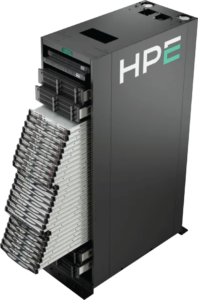
From Components to Co-Engineered Architecture
As AI scales, enterprises are moving away from DIY assembly. Nobody wants to buy a box of high-end components and hope they work together. The market has shifted: Customers don't want parts; they want proven architectures.
By designing compute, networking, storage, and data services in concert, organizations reduce deployment risk, shorten time to value, and create infrastructure that can evolve as AI workloads evolve. System-level balance becomes the differentiator.
Future-ready AI platforms must be designed for velocity, context, and resilience from the start.
The Next Frontier: Data Velocity, Context, and Resilience
The demands placed on AI data pipelines will continue to intensify. Context windows are expanding, increasing pressure on data movement and memory efficiency. Inference is becoming more distributed, spanning data centers, edge locations, and sovereign environments. At the same time, governance, data sovereignty, and cyber resilience are no longer secondary concerns. They are foundational requirements.
Future-ready AI platforms must be designed for velocity, context, and resilience from the start.
The Journey Ahead
Enterprise AI is not a one-year transition. It is a multi-year evolution that will reshape how infrastructure is designed and deployed. Treating the AI data pipeline as the platform provides a foundation for sustained, scalable impact.

Jim O’Dorisio, Senior Vice President & General Manager, Storage, HPE | Jason Hardy, Vice President, Storage Technology, NVIDIA
https://www.hpe.com/us/en/newsroom/blog-post/2026/03/the-ai-data-pipeline-is-the-platform.html?utm_campaign=FY25_AI_GB_GD_WW_WW_Data_Foundation_for_AI&utm_medium=OS&utm_source=LKN&utm_content=521112397