
Best practices to move agentic AI from pilots to AI-native delivery

Why reliable agentic AI starts with workflows, measurable outcomes, and a new delivery model
Enterprises are moving beyond isolated AI features toward intelligent systems that can reason, retrieve knowledge, coordinate tools, and act within business workflows. In this two-part series, we examine what it takes to move agentic AI from pilot to production, and how a composable AI operating fabric can make those capabilities reusable, governed, and measurable across the enterprise.
Executive summary
An AI pilot can prove that a model can generate a useful answer. Production requires something more demanding: a system that works inside a real workflow, uses trusted context, chooses the right form of intelligence, escalates appropriately, and improves through measured outcomes. The shift to AI-native delivery therefore begins with workflow design and an evaluation-led operating model, not with selecting the largest model.
The pilot paradox: A good demonstration is not a production system
Most enterprises are no longer asking whether generative AI can produce a compelling demonstration. The harder question is whether the capability can operate reliably across thousands of real interactions, changing data, multiple products, varied user intent, and different levels of business risk.
This is where many pilots stall. They are designed around a model or a user interface rather than around an end-to-end business outcome. They may answer a question, but they do not consistently retrieve the right enterprise context, invoke the correct workflow, handle exceptions, record what happened, or know when a human should take over.
A production system must coordinate all of those concerns. It must be accurate enough to earn trust, fast enough to fit the experience, economical enough to scale, observable enough to operate, and controlled enough to act safely. That is a systems problem, not simply a model-selection problem.
The broader industry shift is therefore from static applications toward adaptive intelligent systems. Traditional systems deliver predefined rules and workflows. AI-enabled systems add prediction, search, and recommendations. Agentic systems introduce memory, reasoning, planning, tool use, and workflow delivery. The longer-term destination is an enterprise in which intelligence is embedded across experiences and operations, continuously learning from outcomes rather than waiting for every action to be manually initiated.
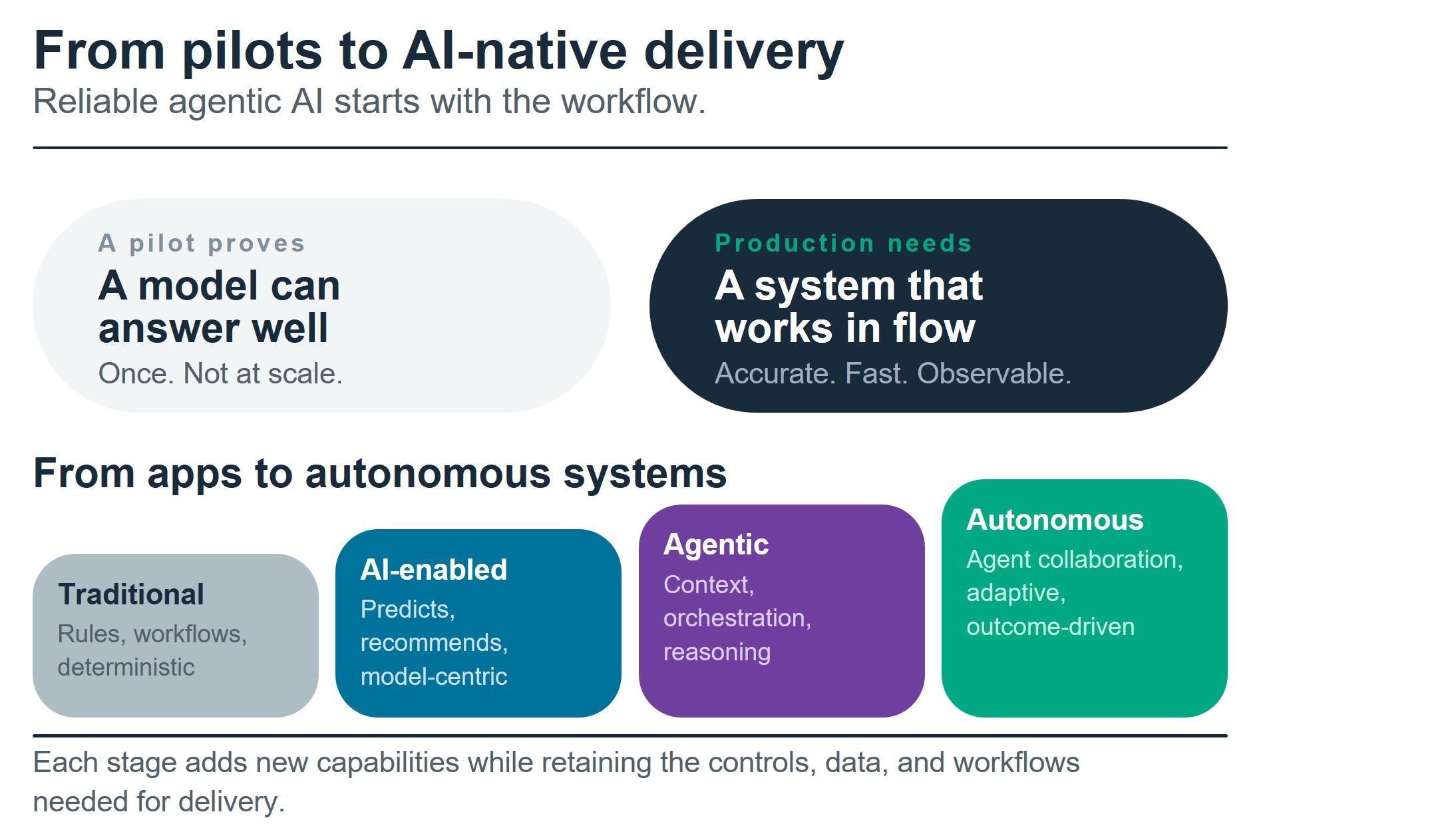
Figure 1. Agentic AI workflow
Start with the workflow—not the model
The most durable lesson from moving AI into production is simple: start with the workflow, not the model. A workflow provides the boundaries that a pilot usually lacks. It identifies the user, the intended outcome, the source of truth, the available actions, the exceptions, the risk level, and the point at which responsibility must transfer to a person.
For a support interaction, the outcome may be to resolve an issue digitally, prepare an engineer with the right context, or route a request to the correct service path. The system must understand what is being asked, retrieve relevant product and customer information, determine which actions are permitted, and present evidence that a user or employee can evaluate. The model is one component within that sequence.
This workflow-first framing also makes use-case selection more disciplined. Strong initial use cases generally have a meaningful business outcome, repeatable inputs, observable completion criteria, and a manageable consequence of error. They are important enough to matter, but bounded enough to evaluate and improve.
A practical use-case test
Before funding a pilot, ask: What outcome will change? Which workflow step will improve? What evidence will show success? What happens when the system is uncertain? Who owns the result after launch?
Hybrid intelligence wins in real enterprise workflows
Agentic AI does not mean that a large language model should make every decision. Enterprise workflows contain different problem types, and each should be handled by the most appropriate mechanism.
- Deterministic rules enforce known policies, eligibility, permissions, and nonnegotiable constraints.
- Classification and traditional machine learning efficiently route intent, prioritize work, detect patterns, and score risk.
- Search and retrieval bring grounded enterprise knowledge into the interaction.
- Large language models interpret language, synthesize context, generate explanations, and support reasoning where inputs are ambiguous.
- Workflow automation and APIs deliver approved actions in systems of record.
- Human-in-the-loop controls provide judgment, accountability, and escalation when confidence or risk requires it.
Consider a complex support request. A lightweight classifier can first identify intent. Retrieval can locate the relevant documentation and known issues. A language model can summarize the evidence and propose next steps. A deterministic policy check can confirm whether an action is allowed. The workflow can then automate a low-risk step or request human approval before a customer-impacting action. This combination is often faster, less expensive, and more reliable than asking one model to do everything.
Human oversight should also be designed by risk rather than added as a universal approval queue. Low-risk, reversible actions may be automated when confidence is high. Medium-risk recommendations can require user confirmation. High-risk, regulated, or financially consequential actions should include explicit review, evidence, and auditability. The objective is not to remove people from every process; it is to place human judgment where it adds the most value.
AI-native development changes how teams deliver software
Production AI also requires a different engineering rhythm. Traditional delivery often assumes that a feature can be specified, built, tested against deterministic requirements, and released. Agentic systems are probabilistic and context-dependent. Their behavior can change when prompts, models, retrieval strategies, knowledge sources, tools, or user patterns change.
AI-native development treats evaluation as part of the product, not as a final testing phase. Teams need representative scenarios, expected outcomes, quality thresholds, safety checks, latency and cost budgets, and feedback from real usage. Changes to prompts, retrieval, routing, or models should move through version control, automated evaluation, controlled release, monitoring, and rollback just like other production software.
This favors smaller, cross-functional teams that combine product, engineering, domain knowledge, data, operations, experience design, and risk expertise. They can release in shorter increments, compare alternatives, observe user behavior, and learn from outcomes without losing operational discipline. The aim is not experimentation without control; it is faster learning inside a controlled system.
The delivery metrics should evolve accordingly. Release-cycle time and engineering velocity remain useful, but they must be paired with measures such as evaluation pass rate, retrieval quality, human acceptance, escalation behavior, user adoption, and time-to-outcome. A team that releases quickly but cannot explain whether the AI is helping the workflow has optimized the wrong thing.
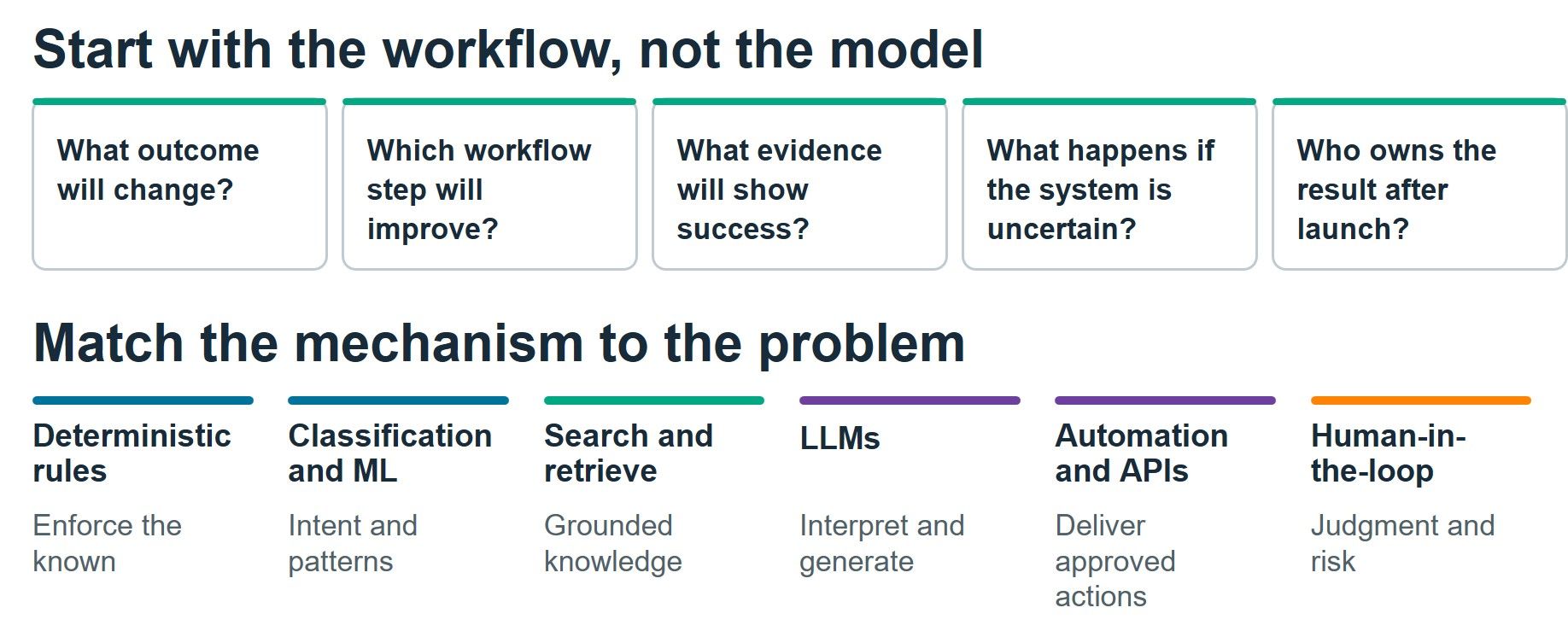
Figure 2. Production AI
Trust and business outcomes must be designed from day one
Trust is not created by a policy document after the system is built. It emerges from the experience of using the system: whether answers are grounded, whether uncertainty is visible, whether recommendations are explainable, whether escalation works, and whether the organization can investigate what happened.
In customer support, the business measures may include digital containment, case deflection, autonomous resolution, resolution cycle time, employee productivity, adoption, and customer satisfaction. Those outcomes should be connected to quality and safety measures such as accuracy, relevance, completeness, confidence, policy adherence, and escalation rate. Cost and latency matter as well, because a capability that is too slow or expensive will not scale even if it performs well in a demonstration.
HPE’s experience using support and services as a proving ground points to the value of this systems approach: reducing avoidable manual handling, improving the ability to resolve issues digitally, accelerating time to resolution, and creating a more consistent experience.
The most important operational question is therefore not how intelligent is the model? It is how reliably does the system improve the outcome, at an acceptable level of risk, cost, and user effort?
From successful use cases to a reusable enterprise capability
A workflow-first approach can move an individual use case into production. But a new scaling challenge appears when every team independently builds its own context handling, retrieval, model routing, tool connections, guardrails, evaluation harness, and telemetry. The organization may create many pilots—and many versions of the same foundation.
That duplication slows delivery, increases cost, makes governance inconsistent, and ties valuable capabilities to whichever interface or vendor pattern was popular when the project began. The durable investment is not a particular copilot screen. It is the reusable intelligence behind the screen: context, knowledge, orchestration, tools, policy, observability, evaluation, and workflow integration.
This leads to the central question for part 2: How can organizations create a shared AI foundation that allows these capabilities to scale across teams, experiences, data sources, and workflows?
In part 2, we will examine the composable AI operating fabric: a layered architecture that allows applications and agents to use shared context, knowledge, models, tools, governance, and continuous evaluation without rebuilding the foundation for every experience.
Key takeaways
- A convincing model demonstration is not the same as a production-grade intelligent system.
- Start with a measurable workflow outcome, then select the right combination of rules, retrieval, machine learning, language models, automation, and human oversight.
- AI-native delivery requires continuous evaluation, short learning cycles, observability, and cross-functional outcome ownership.
- Trust, cost, quality, and business impact should be designed together from the beginning.
- Scaling beyond individual use cases requires a reusable enterprise foundation.

https://community.hpe.com/t5/the-cloud-experience-everywhere/best-practices-to-move-agentic-ai-from-pilots-to-ai-native/ba-p/7273717