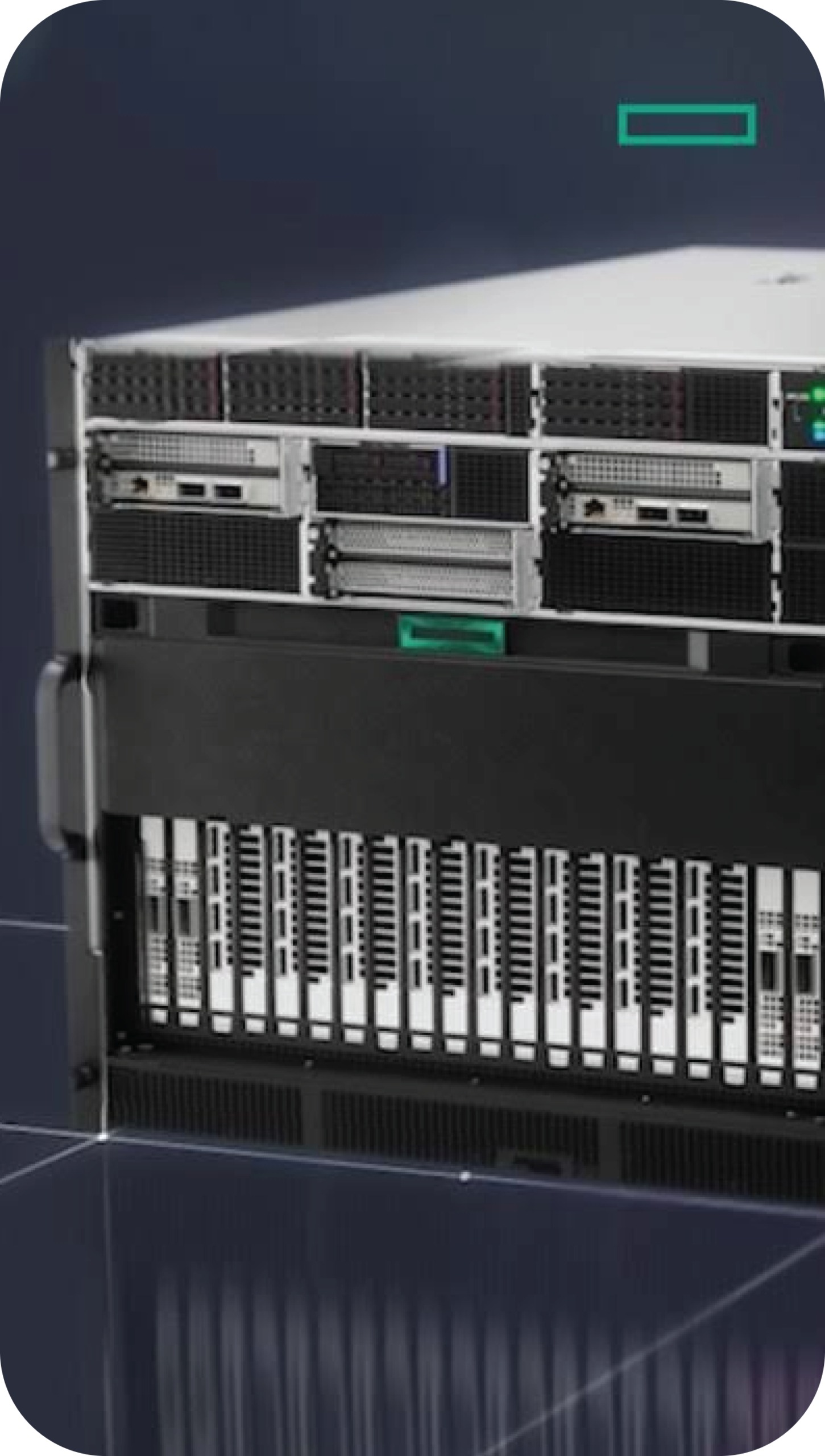
Next-generation HPE ProLiant DL525 and HPE ProLiant DL585a Gen13 Servers deliver higher core density, memory bandwidth and I/O for running compute-intensive workloads at enterprise scale
Built on Open Compute Project (OCP) standards, the HPE ProLiant XD245 and HPE ProLiant XD285 Servers deliver higher rack density with more efficient power distribution and cooling
HOUSTON – Oct. 7, 2026 – HPE (NYSE: HPE) today announced the first four of its HPE ProLiant Gen13 Servers powered by 6th Generation AMD EPYC™ Server processors. The new systems expand compute, memory, and I/O capabilities to help enterprises accelerate agentic AI and inference, analytics, virtualization, simulation, and modeling while strengthening security, simplifying operations, and providing reliability across distributed IT environments.
As AI systems evolve from generating insights to taking autonomous action, trust becomes a prerequisite for scale. McKinsey’s 2026 AI Trust Maturity Survey found that nearly two-thirds of respondents cited security and risk concerns as the top barrier to fully scaling agentic AI. Within this evolving landscape, HPE ProLiant Gen13 helps customers address security and operational barriers with a trusted infrastructure foundation that combines HPE iLO 8 innovations for automatic protection, infrastructure trust, and post-quantum readiness with enhanced visibility and control from HPE Compute Ops Management.
HPE ProLiant Gen13 brings together optimized performance, built-in, automatic security, intelligent operations, and proven reliability.
“Organizations need to turn their investments in agentic AI and inference into business value without adding operational complexity or risk,” said Krista Satterthwaite, senior vice president and general manager, Compute at HPE. “For these workloads, HPE ProLiant Gen13 brings together optimized performance, built-in, automatic security, intelligent operations, and proven reliability. It gives customers a trusted foundation to modernize and innovate today and adapt as their requirements evolve.”
“AI is moving into the applications and operations that run the enterprise, fundamentally changing what organizations demand from their infrastructure,” said Dan McNamara, senior vice president and general manager, Compute and Enterprise AI, AMD. “Across generations of AMD EPYC CPUs and HPE ProLiant servers, our teams have worked side by side to turn advances in processor and system design into practical value for customers. With 6th Gen AMD EPYC processors and HPE ProLiant Gen13, we are delivering the performance, efficiency and flexibility enterprises need to scale AI while modernizing the critical workloads their businesses depend on.”
HPE is reinforcing its leadership in enterprise compute by introducing new HPE ProLiant Gen13 Servers that simplify the path to innovation and give customers the secure foundation needed for the AI era.
AI-ready performance across enterprise workloads
HPE is reinforcing its leadership in enterprise compute by introducing new HPE ProLiant Gen13 Servers that simplify the path to innovation and give customers the secure foundation needed for the AI era. Combining HPE engineering with 6th Gen AMD EPYC Server processors enables delivery of higher core density, memory bandwidth, and I/O capacity.
The HPE ProLiant DL585a Gen13 Server is a future-ready, high-density platform designed to support up to eight double-wide PCIe GPUs, two 6th Gen AMD EPYC Server processors, and PCIe Gen6 connectivity. The server maximizes GPU utilization, token throughput, and PCIe bandwidth at every layer for the most demanding workloads including AI inference, virtualization, retrieval-augmented generation (RAG) model fine-tuning, analytics, and emerging agentic AI.
The HPE ProLiant DL525 Gen13 Server is a compact, performance-optimized 1U, single-socket system powered by one 6th Gen AMD EPYC Server processor with up to 256 cores. High bandwidth 16-channel memory, with support for high-speed and high performance –DDR5 and MRDIMM – and PCIe Gen6 connectivity, make the system ideal for workloads with extremely high data throughput, such as: fraud detection, market-data processing, risk and pricing models, electronic design automation (EDA), simulation, and AI inference.
For large-scale, compute-intensive applications, HPE is also introducing HPE ProLiant XD245 Server and HPE ProLiant XD285 Server – two systems designed to maximize compute performance within a smaller footprint. The two OCP-compliant servers combine high-density compute with efficient shared power and cooling to support data-intensive AI and HPC workloads.
The HPE ProLiant XD245 Server uses a one-Open Rack Unit (1OU), four-node direct liquid-cooled design to deliver high compute density and is powered by up to eight 6th Gen AMD EPYC Server processors.
The HPE ProLiant XD285 Server uses a two-Open Rack Unit (2OU), two-node air-cooled design, extending the architecture to a broader range of data center environments.
Engineered to process large-scale simulations, complex computational models, and datasets at the rack level, these systems provide the capacity, bandwidth, and infrastructure flexibility – cooling and accelerator options – needed for CPU-intensive workloads including computer-aided engineering (CAE), weather and climate modeling, scientific research, and financial modeling.
HPE ProLiant Gen13 will expand beyond the systems announced today, giving customers additional choices for mainstream enterprise, edge, virtualization, software-defined infrastructure, database, and AI workloads.
Automatic security and streamlined operations
HPE ProLiant Gen13 combines automatic security from HPE Integrated Lights-Out 8 (iLO 8) with enhanced HPE Compute Ops Management capabilities to protect data and system integrity while simplifying deployment and lifecycle operations.
New industry-first features, available in HPE ProLiant Gen13, include:
Automatic self-encrypting drive (Auto-SED) server capabilities, first in the industry, protects data at rest from first boot without added configuration, external key managers, or manual activation.
Industry-first multi-person authorization (MPA) requires two authorized users to approve high-impact actions, including key provisioning and secure erase, reducing the risk of single-user error or misuse.
Expanded post-quantum cryptography (PQC) readiness, first in the industry, that now extends beyond firmware to help protect server communication paths from emerging threats.
Enterprise-grade component verification, built upon HPE’s Silicon Root of Trust, validates the authenticity and integrity of critical server components as they are added, replaced, or modified throughout the server lifecycle.
New capabilities from HPE Compute Ops Management help customers operate HPE ProLiant Gen13 infrastructure with greater efficiency and resiliency through low-touch onboarding and near real-time power capacity insights. Organizations using HPE Compute Ops Management spent 50% less time managing servers and generated 209% ROI.
Proven reliability for evolving infrastructure needs
Each new generation of HPE ProLiant undergoes more than 1,000 tests and 10,000 hours of validation to help deliver consistent performance, availability, and resilience enterprises depend on, this includes advanced stress and corner-case testing that push the systems beyond published operating limits. Reliability is the leading HPE ProLiant customer purchase driver, for four consecutive years, with 81% citing reliable performance as a key differentiator from other server vendors and twice-fast support resolution. Additionally, HPE Tech Care Service further strengthens resiliency by delivering up to 97% less unplanned downtime, helping customers prevent, identify, and resolve issues as infrastructure needs change.
We use cookies to improve your experience on our site. By using our site, you consent to cookies.
This website uses cookies
Websites store cookies to enhance functionality and personalise your experience. You can manage your preferences, but blocking some cookies may impact site performance and services.
Essential cookies enable basic functions and are necessary for the proper function of the website.
Name
Description
Duration
Cookie Preferences
This cookie is used to store the user's cookie consent preferences.
30 days
These cookies are needed for adding comments on this website.
Name
Description
Duration
comment_author
Used to track the user across multiple sessions.
Session
comment_author_email
Used to track the user across multiple sessions.
Session
comment_author_url
Used to track the user across multiple sessions.
Session
These cookies are used for managing login functionality on this website.
Name
Description
Duration
wordpress_logged_in
Used to store logged-in users.
Persistent
wordpress_sec
Used to track the user across multiple sessions.
15 days
wordpress_test_cookie
Used to determine if cookies are enabled.
Session
Statistics cookies collect information anonymously. This information helps us understand how visitors use our website.
Google Analytics is a powerful tool that tracks and analyzes website traffic for informed marketing decisions.
Used by Google Analytics to determine which links on a page are being clicked
30 seconds
_ga_
ID used to identify users
2 years
_gid
ID used to identify users for 24 hours after last activity
24 hours
_gat
Used to monitor number of Google Analytics server requests when using Google Tag Manager
1 minute
_gac_
Contains information related to marketing campaigns of the user. These are shared with Google AdWords / Google Ads when the Google Ads and Google Analytics accounts are linked together.
90 days
__utma
ID used to identify users and sessions
2 years after last activity
__utmt
Used to monitor number of Google Analytics server requests
10 minutes
__utmb
Used to distinguish new sessions and visits. This cookie is set when the GA.js javascript library is loaded and there is no existing __utmb cookie. The cookie is updated every time data is sent to the Google Analytics server.
30 minutes after last activity
__utmc
Used only with old Urchin versions of Google Analytics and not with GA.js. Was used to distinguish between new sessions and visits at the end of a session.
End of session (browser)
__utmz
Contains information about the traffic source or campaign that directed user to the website. The cookie is set when the GA.js javascript is loaded and updated when data is sent to the Google Anaytics server
6 months after last activity
__utmv
Contains custom information set by the web developer via the _setCustomVar method in Google Analytics. This cookie is updated every time new data is sent to the Google Analytics server.
2 years after last activity
__utmx
Used to determine whether a user is included in an A / B or Multivariate test.