
Deliver a premium fan experience while reducing operational complexity in high-density venues.
Deliver a better-connected venue experience.
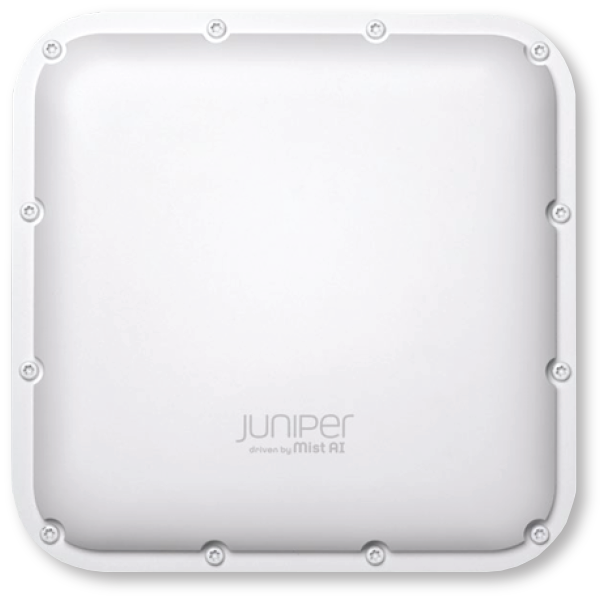
Every part of the event journey depends on reliable wireless connectivity. Fans, guests, employees, vendors, and operations teams use Wi-Fi for mobile ticketing, venue apps, digital payments, concessions, merchandise, workforce devices, asset visibility, smart venue systems, and real-time fan engagement. Large venues also face practical deployment constraints. Under-seat Wi-Fi may not be feasible because of bowl design, structural limitations, installation cost, access restrictions, preservation requirements, or short construction windows between events. HPE Networking AP66D gives venue operators a flexible overhead deployment option that reduces complexity while focusing capacity where people and operations need it most.
The view from above When thousands.
of fans move through stadium concourses, seating areas, entry gates, and premium spaces, operators need visibility into the wireless experience as conditions change in real time. Device density continues to rise, and venues must support more endpoints across fan engagement, payments, workforce mobility, safety, and building operations.
Dense environments often expose the limits of traditional network designs. Dead zones, long concession lines, failed transactions, and inconsistent app performance can quickly affect both attendee experience and operational performance. HPE Networking’s AP66D addresses these challenges moving from reliance on fixed antenna designs to a more suitable approach the optimizes the RF environment based on real-world venue conditions.
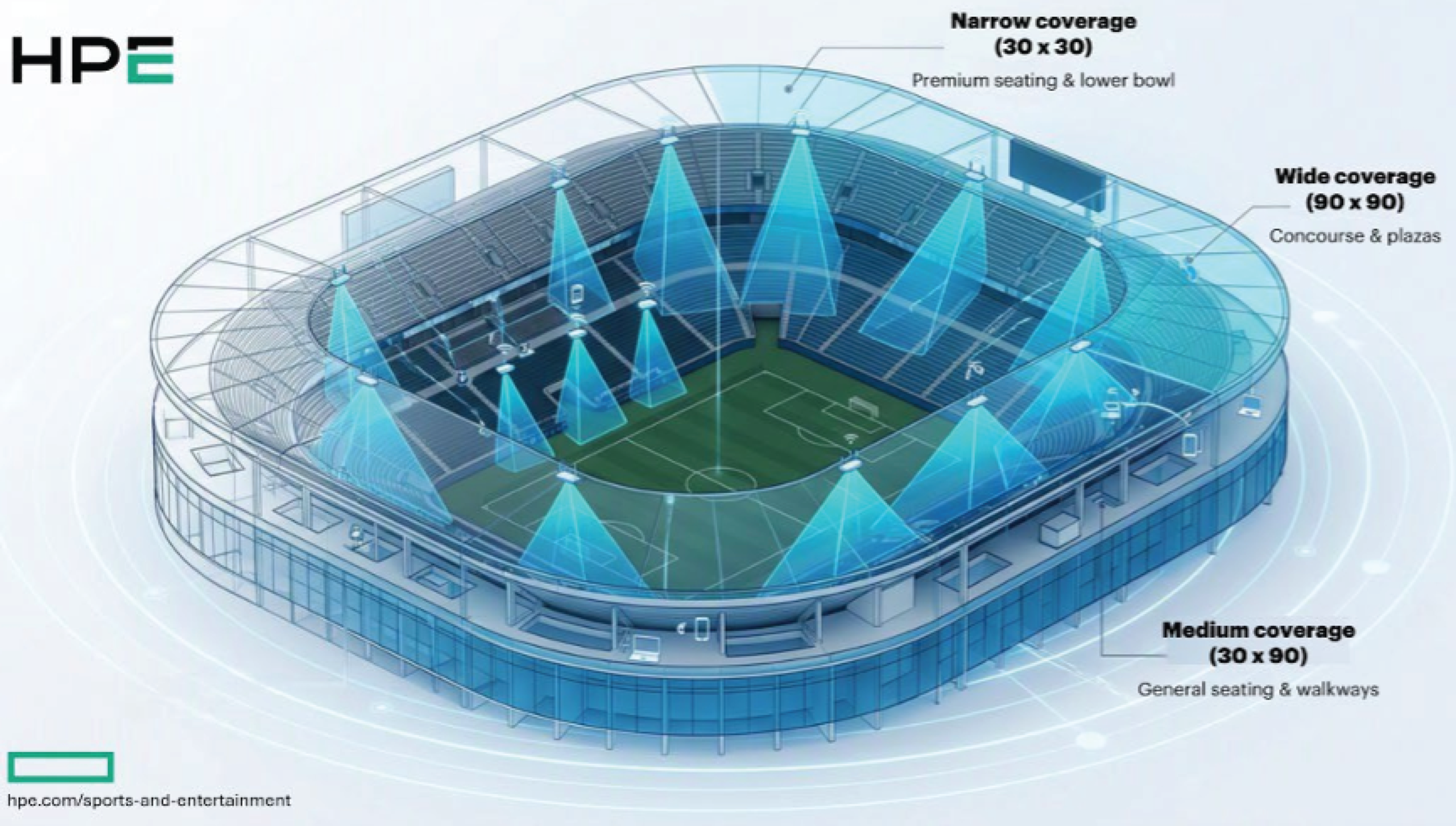
The AP66D combines intelligent RF management with electronically-selectable hyper-directional coverage. This allows venues to adapt coverage for changing crowd density, seating configurations, and operational requirements while maintaining a common hardware platform.
90 x 90-degree coverage for broader overhead zones such as plazas, concourses, hospitality spaces, and mixed-use areas.
90 x 30-degree coverage for elongated seating sections, walkways, entry areas, and directional fan-flow zones.
30 x 30-degree coverage for focused bowl sections, premium seating areas, and locations where tighter RF targeting is needed.
Operational and financial benefits
For venue operators, Wi-Fi design decisions are not simply technical choices, they also affect construction scope, deployment timelines, operational resilience, and long-term cost. AP66D helps simplify large-venue wireless deployments by combining software controlled directional antennas, dual IoT radios, and the AI-native operations of the HPE Mist platform. The result is a design approach that can reduce infrastructure requirements, accelerate time to service, and give IT teams greater confidence during demanding event moments.
Operational requirement
Adapt to different venue zones
Reduce installation complexity
Minimize infrastructure requirements
Accelerate deployment
Support ongoing operations
What AP66D delivers
Integrated directional antenna settings support multiple overhead coverage profiles.
Directional antennas are built into the AP, reducing the need for separate antenna assemblies in many locations.
Overhead placements can reduce the total number of AP locations compared with dense under-seat approaches.
A common AP platform and overhead mounting approach can reduce seat-level construction work.
AI-native operations through Juniper Mist provide service visibility, RF insights, and troubleshooting support.
Benefit
Use one platform across a variety of spaces and deployment scenarios.
Simplify staging, mounting, alignment, documentation, and maintenance.
Reduce switch port needs, cable drops, patching, mount points, and field-service touchpoints.
Improve time to service and reduce disruption during narrow venue access windows.
Help IT teams maintain wireless service through sold-out events and high-demand moments.
Capacity planning for overhead and under-seat designs
Venue Wi-Fi capacity is decided on AP density, channel plan, band utilization, antenna pattern, client behavior, application mix, interference, and available wired backhaul. A simple planning model is: aggregate venue capacity equals the number of APs multiplied by usable per-AP throughput. Under-seat deployment can provide very high AP density, but often requires more cabling, switch ports, installation labor, physical protection, and seat-level work. By leveraging AP66D in an overhead design venues can reduce their infrastructure footprint and improve the user experience.
Deployment approach
Under-seat high-density
Overhead AP66D directional
Hybrid venue design
Example venue size
60,000 seats
60,000 seats
60,000 seats
Planning density
1 AP per 75 seats
1 AP per 150 seats
Overhead bowl plus targeted high-density zones
Estimated AP count
Approx. 800 APs
Approx. 400 APs
Variable
Implication
Highest aggregate AP-count baseline, with the greatest switch port, cabling, labor, and seat-level installation requirements.
About 50% of the AP-count if usable per-AP throughput is similar, with about 50% fewer AP locations, switch ports, and cable drops.
Balances coverage, capacity, budget, and construction constraints by increasing density where demand is highest.
Large venue deployment scenarios
Seating bowls and arenas: Overhead directional coverage can focus Wi-Fi toward seating sections while reducing unnecessary spillover into adjacent areas.
Entry gates, plazas, and parking areas: Outdoor-ready coverage can support mobile ticket validation, credential scanning, security operations, staff devices, and guest wayfinding.
Concourses and concessions: Wi-Fi can support mobile ordering, POS systems, merchandising kiosks, digital signage, and operational handhelds.
Premium clubs, suites, and hospitality spaces: Targeted coverage can support high-value guest experiences, streaming, venue apps, real-time statistics, and private event operations.
Event operations and workforce mobility: Reliable wireless access can support security, medical, maintenance, catering, cleaning, AV, and venue management workflows.
Smart venue and IoT initiatives: The network can support sensors, asset visibility, environmental monitoring, crowd-flow systems, and connected building services.
Designed for event-day reliability
Venue networks are under the greatest pressure during the highest-value moments: gates opening, intermissions, halftime, encore sets, checkout peaks, and post-event exits. AP66D combines Wi-Fi 7 performance, directional overhead deployment flexibility, ruggedized design, and Juniper Mist AI-native operations to help venue teams maintain service visibility and respond quickly when conditions change.
− Service-level visibility helps teams understand whether users are getting the wireless experience they need.
− Automated RF optimization helps adapt to changing venue conditions and interference patterns.
− Root cause analysis and proactive troubleshooting can reduce manual investigation during live events.
− A dedicated scanning radio supports RF visibility without taking capacity away from client-serving radios.
Why AP66D for overhead large venue Wi-Fi
AP66D enables reliable, high-capacity overhead wireless coverage while helping venues reduce deployment complexity, infrastructure needs, and time to service.
− Flexible coverage: multiple integrated antenna options support different venue layouts and use cases with a single product.
− Simplified deployment: integrated antennas reduce the need for separate external antenna assemblies and custom fabrication in many locations.
− Lower infrastructure burden: overhead designs can reduce switch port requirements, cable drops, installation points, and maintenance touchpoints compared with dense under-seat deployments.
− Faster time to service: a common platform and overhead approach can help teams deploy during limited access windows and avoid extensive seat-level construction.
− Operational confidence: Juniper Mist AI-native operations help IT teams monitor, optimize, and troubleshoot the network during high-demand events.
− Venue-ready design: ruggedized construction supports outdoor, semi-outdoor, and exposed areas common to stadiums, arenas, and entertainment districts.
Summary
Large venues need Wi-Fi designs that meet rising fan expectations without adding unnecessary operational complexity. The network must support revenue-generating services, safety workflows, event operations, and connected guest experiences across every part of the venue. AP66D gives operators a flexible overhead deployment option that combines integrated directional antennas, ruggedized Wi-Fi 7 performance, and AI-native operations. This approach can help reduce installation complexity, lower infrastructure requirements, accelerate time to service, and deliver more consistent connectivity across seating bowls, concourses, hospitality spaces, entry areas, outdoor zones, and operational environments.

https://www.hpe.com/psnow/doc/a00163732enw?from=app§ion=search&isFutureVersion=true?utm_campaign=FY25_EG_GB_GD_WW_WW_Secure_AI-Native_Network_Connected_En&utm_medium=OS&utm_source=LKN&utm_content=521112665